
 Chinese
DC-DC Converters for Electric Vehicles (EV): How They Work
A DC-DC converter is a critical component in modern electric vehicles, responsible for managing voltage conversion withizn the vehicle's power system. EV batteries typically operate at high voltages—often ranging from 200V to 800V—while many onboard systems require much lower voltages, such as 12V or 24V.
This is where the DC-DC converter plays a key role. It steps down high-voltage DC power from the traction battery to a usable level for auxiliary systems, including lighting, infotainment, sensors, and control units. Without this conversion, most electronic components in the vehicle would not function properly. In essence, the DC-DC converter acts as a bridge between the high-power battery system and low-voltage electronics, ensuring safe and reliable energy distribution.
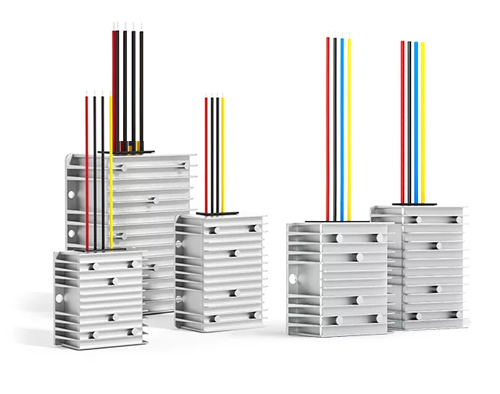
How Does a DC-DC Converter Work in an EV?
The operation of a DC-DC converter in an electric vehicle is based on switching power conversion technology. It regulates voltage by rapidly switching electrical signals on and off, using components such as inductors, capacitors, and transformers.
The basic working process includes:
- Receiving high-voltage DC input from the EV battery
- Switching the current at high frequency
- Adjusting voltage levels through energy storage components
- Delivering stable low-voltage output to onboard systems
This process ensures that power is transferred efficiently with minimal energy loss. Advanced converters also include control circuits that continuously monitor voltage levels and adjust output in real time to maintain stability under varying load conditions.
Why DC-DC Converters Are Essential in EV Systems
Electric vehicles rely on a wide range of electronic systems, all of which require stable and reliable power. A DC-DC converter ensures that these systems receive the correct voltage regardless of battery fluctuations.
Without a DC-DC converter:
- Low-voltage systems would not operate properly
- Sensitive electronics could be damaged by high voltage
- Power distribution would become inefficient and unsafe
Additionally, DC-DC converters eliminate the need for a separate low-voltage battery charging system by directly converting energy from the main battery. This simplifies the vehicle design and improves overall efficiency.
Types of DC-DC Converters Used in EVs
Different types of DC-DC converters are used in electric vehicles depending on the application and design requirements.
1. DC-DC Buck Converters (Step-Down)
These buck converters reduce voltage from a higher level to a lower level. They are the most commonly used type in EVs, as they convert high battery voltage to 12V or 24V for auxiliary systems.
2. DC-DC Boost Converters (Step-Up)
DC DC boost converters increase voltage from a lower level to a higher level. While less common in EV auxiliary systems, they are used in specific applications where voltage needs to be increased.
3. Isolated DC-DC Converters
These isolated converters provide electrical isolation between input and output circuits, improving safety and reducing interference. They are widely used in automotive and high-voltage environments.
4. Bidirectional DC-DC Converters
Bidirectional converters allow power to flow in both directions. This is particularly important in advanced EV systems, such as regenerative braking and energy storage integration.
DC-DC buck-boost converters are also used in certain EV applications where both step-up and step-down capabilities are required, especially in systems with wide voltage variation or bidirectional energy flow.
Key Benefits of DC-DC Converters in Electric Vehicles
DC-DC converters provide several important advantages in EV applications:
- Efficient energy conversion: Minimizes power loss during voltage conversion
- Stable power supply: Ensures consistent voltage for sensitive electronics
- Compact design: Reduces overall system size and weight
- Improved safety: Protects low-voltage systems from high-voltage exposure
- Enhanced system integration: Simplifies overall vehicle power architecture
DC-DC Converter Applications in EV Systems
In electric vehicles, DC-DC converters are used across multiple subsystems to support various functions.
- 1. Auxiliary Power Supply: Provides power to essential systems such as lighting, infotainment, HVAC, and control modules.
- 2. Battery Management Systems (BMS): Supports voltage regulation and monitoring within the battery system.
- 3. Charging Systems: Plays a role in managing energy flow during charging and discharging processes.
- 4. Electric Power Steering and Sensors: Ensures stable power delivery to precision systems that require consistent voltage.
Efficiency and Thermal Management Considerations
Efficiency is one of the most important factors in DC-DC converter design. Higher efficiency means less energy is wasted as heat, which improves overall vehicle performance and extends driving range. Modern EV DC-DC converters often achieve efficiency levels above 90%, thanks to advanced semiconductor technologies and optimized circuit designs. However, thermal management remains a key challenge. As power levels increase, heat generation must be carefully managed through
- Heat sinks
- Cooling systems
- Advanced materials
- Proper thermal design ensures long-term reliability and consistent performance.
Future Trends in EV DC-DC Converter Technology
As electric vehicles continue to evolve, DC-DC converter technology is also advancing rapidly. Key trends include:
- Higher efficiency designs using wide bandgap semiconductors (SiC, GaN)
- Compact and lightweight solutions for improved vehicle performance
- Bidirectional energy flow for smart energy management
- Integration with smart control systems for real-time optimization
These innovations are helping improve energy efficiency, reduce system complexity, and support the growing demands of next-generation EVs.
Conclusion
DC-DC converters play a vital role in electric vehicles by enabling efficient voltage conversion and stable power distribution. From supporting low-voltage electronics to improving overall system performance, they are essential to modern EV design. As technology continues to advance, DC-DC power converters will become even more efficient, compact, and intelligent, further enhancing the performance and reliability of electric vehicles.