
 Chinese
DC-DC Converter Application in Industrial Control System
In modern industrial control systems, the stability and efficiency of the power supply directly impact the reliability and performance of the entire system. With the widespread adoption of automation equipment, PLC controls, industrial robots, and embedded control units, DC-DC converters (direct current to direct current converters) have become indispensable power modules.
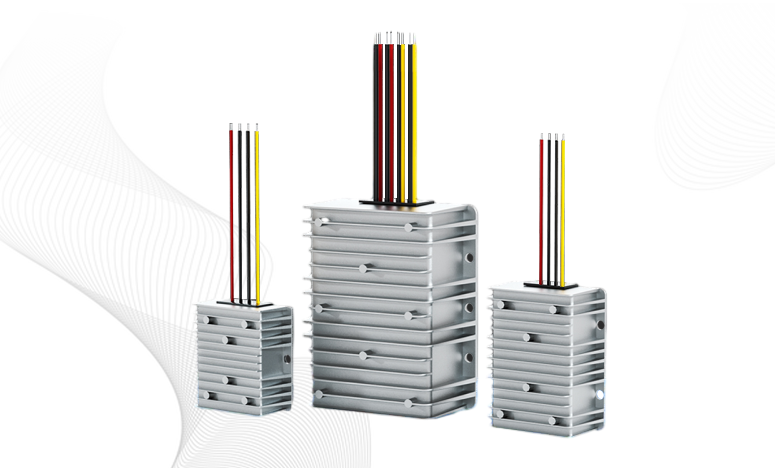
What is a DC-DC Converter?
A DC-DC converter is a power electronic device that converts one DC voltage level to another. For example, it might convert a 24V industrial bus voltage to 12V, 5V, or 3.3V for use by control circuits.
Depending on the circuit topology, common types include:
- Buck Converter: Steps down high voltage to low voltage.
- Boost Converter: Steps up low voltage to high voltage.
- Buck-Boost Converter: Capable of both stepping up and stepping down voltage.
- Isolated Converter: Provides electrical isolation between input and output to enhance safety.
Why are DC-DC Converters Essential in Industrial Control Systems?
Industrial power environments are complex, presenting common challenges such as:
- Voltage fluctuations (e.g., a 24V system might vary between 18V and 30V)
- Electromagnetic interference (EMI)
- Multiple voltage requirements (coexistence of 24V, 12V, 5V, and 3.3V)
- Voltage drops over long-distance power transmission
DC-DC converters address these complex conditions by providing:
- Stable voltage output: The output remains constant despite input voltage fluctuations, ensuring the stable operation of PLCs and sensors.
- Improved system efficiency: Compared to linear regulators, switching DC-DC converters typically achieve efficiencies of 85%–95%, significantly reducing heat generation.
- Voltage isolation: In industrial environments, isolated DC-DC converters effectively prevent ground loop interference and enhance system safety.
- Multi-voltage distribution: A single 24V input can be distributed via multiple DC-DC modules into different voltages (such as 5V or 12V) to power various system components.
Typical Industrial Application Scenarios
- Powering PLCs and Controllers: PLCs typically require a stable 5V or 3.3V logic power supply, whereas the power provided in industrial settings is usually 24V DC. The DC-DC converter steps down the 24V input to ensure the stable operation of the CPU and I/O modules.
- Industrial Robot Systems: Industrial robots contain control boards (low voltage), servo drives (medium-to-high voltage), and sensor systems (low power consumption). DC-DC converters implement a multi-stage power architecture, ensuring that different modules operate independently and stably.
- Sensors and IoT Nodes: Industrial sensors (measuring temperature, pressure, vibration, etc.) typically require low-power supplies. In this context, DC-DC converters step down voltage from 24V to 3.3V or 5V, extend the battery life or operational time of energy-harvesting systems, and reduce standby power consumption.
- Industrial Communication Equipment: Devices such as industrial switches, RS485/RS232 modules, and CAN communication nodes are highly sensitive to power supply noise; therefore, low-ripple DC-DC power modules must be used.
- Auxiliary Power for Motor Drive Systems: In BLDC motor drives (e.g., for fans, electric boats, or power tools), the power supplies for the main power stage and the control stage are usually separated: the main power supply drives the motor (high current), while the control power supply powers the MCU and Hall sensors (low voltage). The DC-DC converter provides a clean, stable power supply for the control circuitry.
Comparison of DC-DC Converters vs. Linear Regulators
| Feature | DC-DC Converter | Linear Regulator |
| Efficiency | High (85–95%) | Low (30–60%) |
| Heat Generation | Low | High |
| Size | Compact | Larger (requires heat sinking) |
| Noise | Has switching ripple | Very low |
| Industrial Suitability | High | Moderate |
Summary
DC-DC converters act as the power hub in industrial control systems. Beyond mere voltage conversion, they play a critical role in ensuring stability, system isolation, and interference immunity. Whether in PLC control, industrial robotics, sensor networks, or motor drive systems, DC-DC converters are fundamental components that ensure reliable system operation.