
 Chinese
DC Buck-Boost Converters: Typical Step-Up and Step-Down Voltage Ranges and Applications
In modern electronic and industrial systems, DC power sources are rarely perfectly stable. Whether the power comes from batteries, photovoltaic systems, or industrial DC buses, the input voltage often fluctuates due to load changes, environmental conditions, or operating states. Without proper voltage regulation, these fluctuations can affect system performance, reduce reliability, or even cause equipment failure. DC buck-boost converters are designed to solve this problem. They can maintain a stable output voltage whether the input voltage is higher than, lower than, or close to the required output voltage. As a result, they have become an essential component in a wide range of electronic, industrial, and energy-related applications.
1. What Is a DC Buck-Boost Converter?
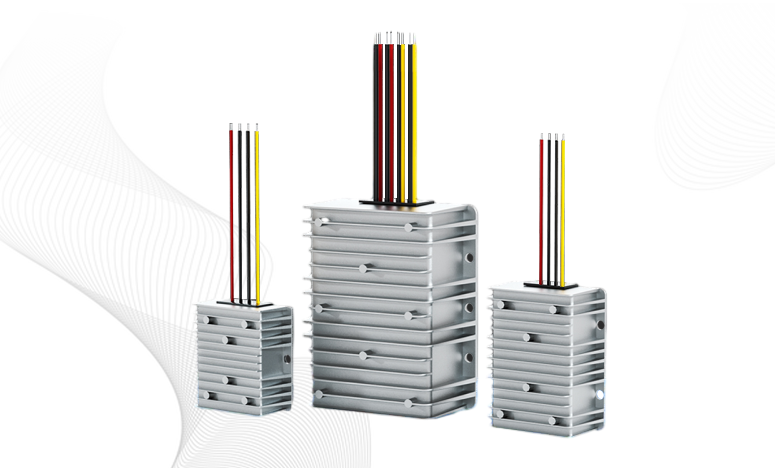
A DC buck-boost converter is a type of DC-DC power converter that combines both step-down (buck) and step-up (boost) functions in a single circuit or module. Unlike traditional converters that can only increase or only decrease voltage, a buck-boost converter can operate across a much wider input voltage range.
In many real-world applications, the input voltage may cross above and below the desired output voltage. A typical example is a battery-powered system, where the battery voltage gradually decreases during discharge. In such cases, using only a buck or boost converter would result in unstable operation during part of the voltage range. A buck-boost converter, however, can seamlessly switch operating modes to ensure continuous and stable outpu
Its main advantages include:
- Wide input voltage range and strong adaptability
- Stable output voltage with fast dynamic response
- High conversion efficiency, reducing energy loss
- Simplified power system design
2. Low-Power DC Buck-Boost Converters (Portable and Consumer Electronics)
Low-power DC buck-boost converters are commonly used in portable devices and consumer electronics. These systems are typically powered by batteries and place strict requirements on size, efficiency, and power consumption. Since battery voltage changes significantly with state of charge, the input voltage often varies continuously, making buck-boost converters an ideal solution for voltage regulation.
Typical voltage ranges include:
Input voltage:- 2V – 5V (single-cell lithium batteries, coin cells)
- 3V – 12V (multiple dry cells or small battery packs)
- 3.3V (commonly used for MCUs and sensors)
- 5V (USB devices and logic circuits)
- 9V / 12V (certain modules or peripherals)
Key application characteristics:
- Input voltage frequently crosses the output voltage level
- Input voltage frequently crosses the output voltage level
- Integrated protection such as overcurrent, overvoltage, and short-circuit protection
3. Medium-Power DC Buck-Boost Converters (Industrial and Communication Systems)
In industrial automation, communication equipment, and control systems, power supply reliability is critical to overall system stability. Medium-power DC buck-boost converters are often used as internal regulated power supplies, providing stable DC voltage for control units, communication modules, and actuators.
Industrial power environments are typically harsh, with voltage fluctuations, electrical noise, and sudden load changes. Therefore, these converters are designed with wide input voltage ranges, strong immunity to interference, and comprehensive protection mechanisms.
Typical voltage ranges include:
Input voltage:- 9V – 36V
- 12V – 48V (common industrial DC bus levels)
- 5V (control and logic circuits)
- 12V (relays and communication modules)
-
24V (industrial actuators)
Main characteristics include:
- Ability to withstand voltage fluctuations and transients
- Higher output power and current capability
- Designed for long-term, continuous operation
4. High-Power DC Buck-Boost Converters (Renewable Energy and Automotive Systems)
In renewable energy, energy storage, and automotive systems, DC voltage ranges are often much wider and power levels significantly higher. For example, photovoltaic arrays, battery packs, and vehicle DC buses exhibit large voltage variations depending on operating conditions. In these cases, a single buck or boost converter is usually insufficient.
Common voltage configurations include:
Input voltage:
- 18V – 60V
- 30V – 100V (PV arrays and battery packs)
Output voltage:
- 24V
- 36V
- 48V
Key application requirements include:
- Wide input voltage range adaptability
- High efficiency to minimize heat generation
- High efficiency to minimize heat generation
5. Applications in Battery-Powered Systems
In battery-powered systems, voltage variation with state of charge is one of the most common challenges. Battery voltage can differ significantly between fully charged, partially charged, and low-charge states. Supplying power directly to the load can easily lead to unstable operation or reduced performance. By incorporating a DC buck-boost converter, a stable output voltage can be maintained throughout the entire discharge cycle, greatly improving system reliability and user experience.
Main benefits include:
- Main benefits include:
- Safe voltage step-down when battery voltage is high
- Extended usable operating time for the device
6. Applications in Renewable Energy Systems (Solar and Energy Storage)
In solar and energy storage systems, DC buck-boost converters play a critical role in voltage matching and energy regulation. Since photovoltaic output voltage varies significantly with sunlight intensity and temperature, directly connecting it to a DC bus can reduce system efficiency or cause instability. Buck-boost converters dynamically adjust voltage based on operating conditions, allowing the system to operate at optimal performance and improving overall energy utilization.
Key application benefits include:
- Voltage matching between PV modules and battery systems
- Stabilization of the DC bus voltage
- Improved overall system efficiency
Thanks to their wide input voltage range, stable output capability, and high adaptability, DC buck-boost converters have become a key component in modern electronic and power systems. From low-power portable devices to high-power renewable energy and automotive applications, buck-boost converters of different voltage ranges and power levels provide flexible and reliable power solutions.
In practical applications, understanding typical step-up and step-down voltage ranges and selecting the appropriate converter for each scenario is essential for achieving long-term system stability and optimal performance.